
A square face shape is defined by a strong, sculpted jawline, a broad forehead, and cheekbones that align almost vertically with the temples and jaw corners. Those clean architectural lines photograph beautifully and age remarkably well, yet they can sometimes feel overly stern when paired with blunt, boxy haircuts or stiff geometric collars.
Great styling for a square face is never about hiding your bone structure. It is about counterbalancing sharp angles with curved lines, diagonal movement, and softness—so your jawline looks intentional and striking rather than rigid.
Before changing your haircut or wardrobe, make sure you are judging your face from a true camera distance rather than a close-up selfie (how to take a photo for style analysis), or explore how a complete visual plan approaches facial framing in our sample styling report.
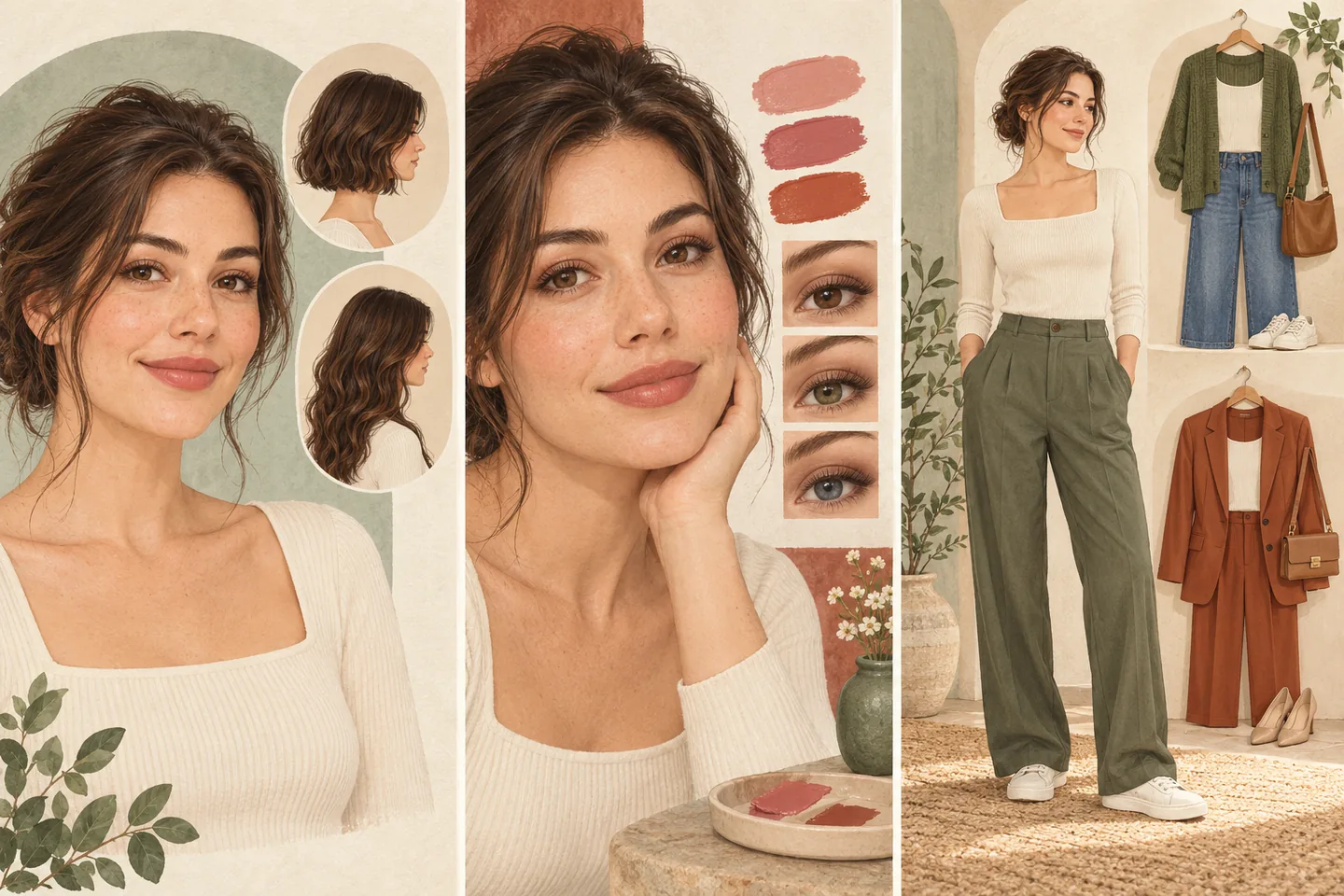
Illustrative AI-generated image: Softening a strong jawline by coordinating diagonal hair movement, luminous cheek placement, and an open collar.
How to recognize a square face shape
Stand in natural daylight with your hair pulled back and look at three landmarks:
- Forehead, cheekbone, and jaw width: All three horizontal measurements look very close in width, creating straight vertical sides from temple to jaw.
- An angled jaw corner: Where your jaw turns toward your chin, there is a distinct corner rather than the continuous curve of a round face shape or the narrow taper of a heart-shaped face.
- A relatively flat chin line: The bottom of the chin is subtly squared or broad rather than pointed.
If your face has this same angular jaw and broad forehead but is noticeably longer than it is wide, you have an oblong/rectangular face—in which case you can combine the jaw-softening tips below with the length-balancing advice in our diamond and long face guide.
Haircuts and parting that complement a strong jawline
The golden rule for a square face is avoiding straight horizontal lines that stop at the jaw corners or eyebrows:
- Collarbone-to-chest lengths with graduated layers: Cuts that end two inches above or below the jawline—rather than right on the jaw corner—keep the eye moving vertically. Ask your stylist for wispy, tapered ends rather than a heavy, razor-straight blunt perimeter.
- Soft waves and textured bends: Loose S-waves or a slight bend with a curling iron introduce rounded curves beside the temples and jaw.
- Side parts and diagonal curtain bangs: A thick, straight-across blunt fringe creates a harsh rectangle with a square jawline. Instead, choose a side part or long, feathered curtain bangs that sweep past the outer corners of the eyes and cheekbones.
- If you love short hair: Opt for a textured pixie with volume at the crown and soft, wispy sideburns, or an angled lob that is slightly longer in the front to break up the horizontal jaw line.
Read how to try a new hairstyle before you cut it and use our checklist on how to explain your next haircut before your next appointment, or find a vetted salon in our city personal stylist and salon directory.
Makeup placement: roundness and glow in the center
Because a square face already has natural bone definition along the outer edges, heavy contour can easily look harsh:
- Rounded, diffused blush on the apples: Apply cream or powder blush to the rounded apples of the cheeks and blend softly toward the cheekbones in an oval motion. This introduces warmth and curves in the center of the face.
- Softly curved brows: Avoid drawing boxy, squared-off inner brow corners or sharp 90-degree peaks. A softly curved brow with a feathered front softens the upper frame of the face.
- Luminous center highlights: Place subtle highlighter on the high points of the cheekbones, the center of the forehead, and the tip of the chin to draw the eye to the middle of the face rather than the outer jaw corners.
- Softly diffused lip edges: Satin lips, tinted balms, or lipsticks with softly blended edges complement angular bone structure beautifully.
Necklines, collars, and earrings: curves over squares
Your neckline sits directly beneath your jawline—meaning the shape of your collar either echoes your jaw or balances it:
- Scoop necks, cowl necks, wrap tops, and U-necks: Curved necklines and diagonal wrap fronts soften the transition from chin to chest.
- What to limit: Stiff, wide square necklines and rigid high boat necks repeat the exact geometry of a square jaw. If you wear a structured blazer or button-down shirt, leave the top buttons open to create a softer V-drop, or wear a silk or soft knit shell underneath.
- Earring and eyewear shapes: Round hoops, oval drops, pearl clusters, and teardrop earrings introduce curves right next to the jaw angle. Similarly, if you wear glasses, oval, round, or softly upswept frames counteract a square jaw much better than sharp rectangular frames—see how to build a look around your glasses.
A 10-minute home mirror test
Test this contrast today using pieces you already own:
- Put on a stiff collared shirt buttoned high (or a square-neck top) with your hair parted in the center and tucked flat behind your ears. Take one photo in natural window light.
- Switch to a scoop-neck, wrap top, or open-collar shirt, shift your hair part to one side, pull a few soft face-framing pieces loose around your temples, and put on a pair of rounded hoop or drop earrings.
- Take a second photo from the same spot and compare how the curved lines highlight your eyes and cheekbones while letting your jawline look effortlessly sculpted.
Want to see two tailored visual directions on your own photo? Explore our AI makeover preview guide or see our one-time $19.90 plan details.