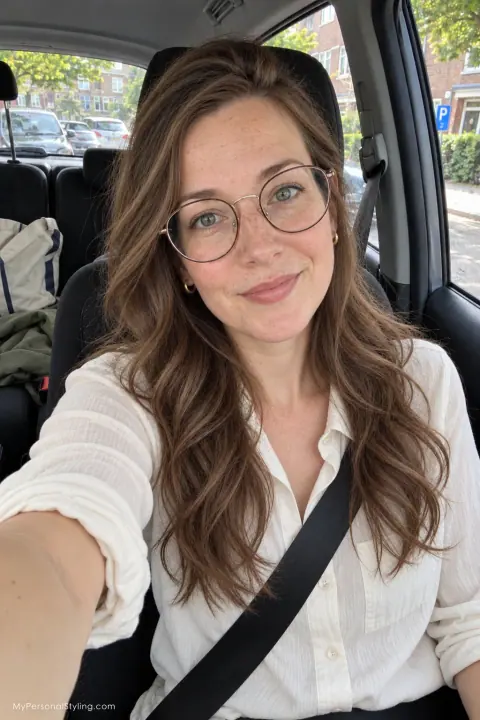
Having a round face shape means your cheeks are softly curved, your jawline has a gentle arc rather than sharp corners, and the vertical length of your face is close to its horizontal width. Those soft contours are naturally approachable and youthful, yet they can sometimes make standard haircut advice or high-necked tops feel cramped around the chin and cheeks.
Good styling for a round face is not about hiding your features or forcing your face to look like another shape. Instead, it is about visual balance: introducing subtle vertical and diagonal lines through your haircut, makeup placement, neckline, and accessories so your features have breathing room.
Before changing anything, remember that a close-up phone selfie often makes every face look wider and rounder than it is in real life due to wide-angle lens distortion. If you want an accurate baseline before testing ideas, follow our guide on how to take a photo for style analysis or inspect how a complete visual plan evaluates proportions in our sample styling report.
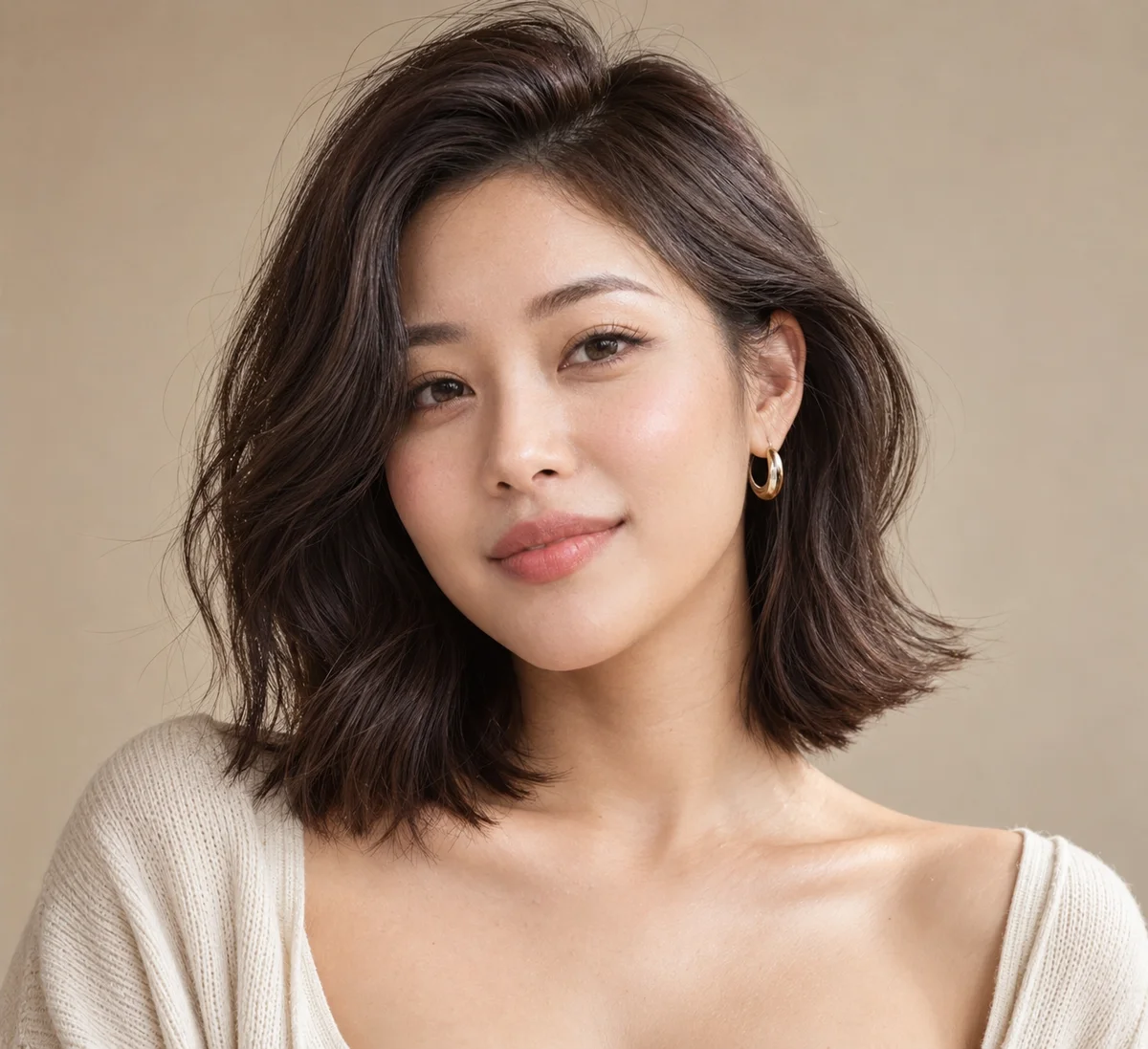
Illustrative AI-generated styling reference: A collarbone-length long bob (lob) with a deep side part creates diagonal movement and elongates the neckline.
How to confirm if your face shape is primarily round
Instead of measuring your face with a ruler—which rarely accounts for hair volume or three-dimensional cheek structure—stand at arm's length from a mirror in even daylight with your hair pulled back:
- Compare width and length: Look at the distance from your hairline to your chin versus the distance across your cheekbones. On a round face, these two visual spans look very similar.
- Check the jawline curve: Notice where your jaw turns toward your chin. A round face has a smooth, continuous curve rather than an angled corner (which points toward a square face) or a narrow, pointed chin (which points toward a heart shape).
- Observe where fullness sits: Fullness is typically centered at the apples of the cheeks and the mid-face.
As we explain in can an AI styling app choose a look from your face shape and skin tone, most people are a blend of two shapes—such as round-oval or round-heart. Treat "round face" as a helpful starting direction rather than a rigid box.
Haircuts and parting that add vertical flow
When hair ends right at the widest part of the cheeks or jawline, it draws a horizontal line across the center of the face. The simplest adjustment is to shift where the eye travels vertically and diagonally:
- Collarbone-length lobs and long layers: A cut that finishes two to three inches below the chin—resting near the collarbone—draws the eye downward. Ask your stylist for face-framing layers that start below the cheekbones rather than at ear level so they do not add side bulk.
- Deep side parts and off-center parts: A dead-center part mirrors both sides of the face and emphasizes symmetry and width. Shifting your part even half an inch to one side creates an asymmetric diagonal line across the forehead.
- Long curtain bangs or side-swept fringe: Heavy, blunt horizontal bangs cut straight across the brow shorten the visible forehead and make the lower half of the face feel wider. Soft curtain bangs that part in the middle and taper past the temples keep the forehead open while framing the outer cheeks.
- Crown volume over side volume: If you style with a round brush or rollers, lift the roots at the crown rather than puffing out the sides next to the ears.
Before booking a salon appointment, read how to try a new hairstyle before you cut it and bring specific placement notes using how to explain your next haircut. If you want in-person advice from a consultation-first hairstylist, browse our verified city personal stylist and hair salon directory covering London, New York City, Singapore, Seoul, and Sydney.
Everyday makeup placement: lift without heavy contouring
Harsh, dark contour stripes often look muddy in natural daylight. For a round face, subtle upward placement of your everyday products creates definition while looking like skin:
- Angled blush placement: Instead of swirling blush onto the center apples of your cheeks while smiling, place your blush slightly higher on the cheekbone and blend upward toward the temples. This lifts the visual center of the cheek.
- Brows with a soft, defined peak: A completely flat brow adds a horizontal bar across the face, while an overly sharp arch can look unnatural. Aim for a gentle, structured peak two-thirds of the way along the brow, tapering cleanly toward the tail.
- Outer-corner eye focus: Extending your eyeshadow or soft liner slightly upward at the outer corners—and concentrating mascara on the outer half of your upper lashes—draws attention outward and upward.
- Center-of-face luminosity: A touch of satin highlighter or brightening concealer on the bridge of the nose, the center of the forehead, and the center of the chin brings forward the vertical axis of your face.
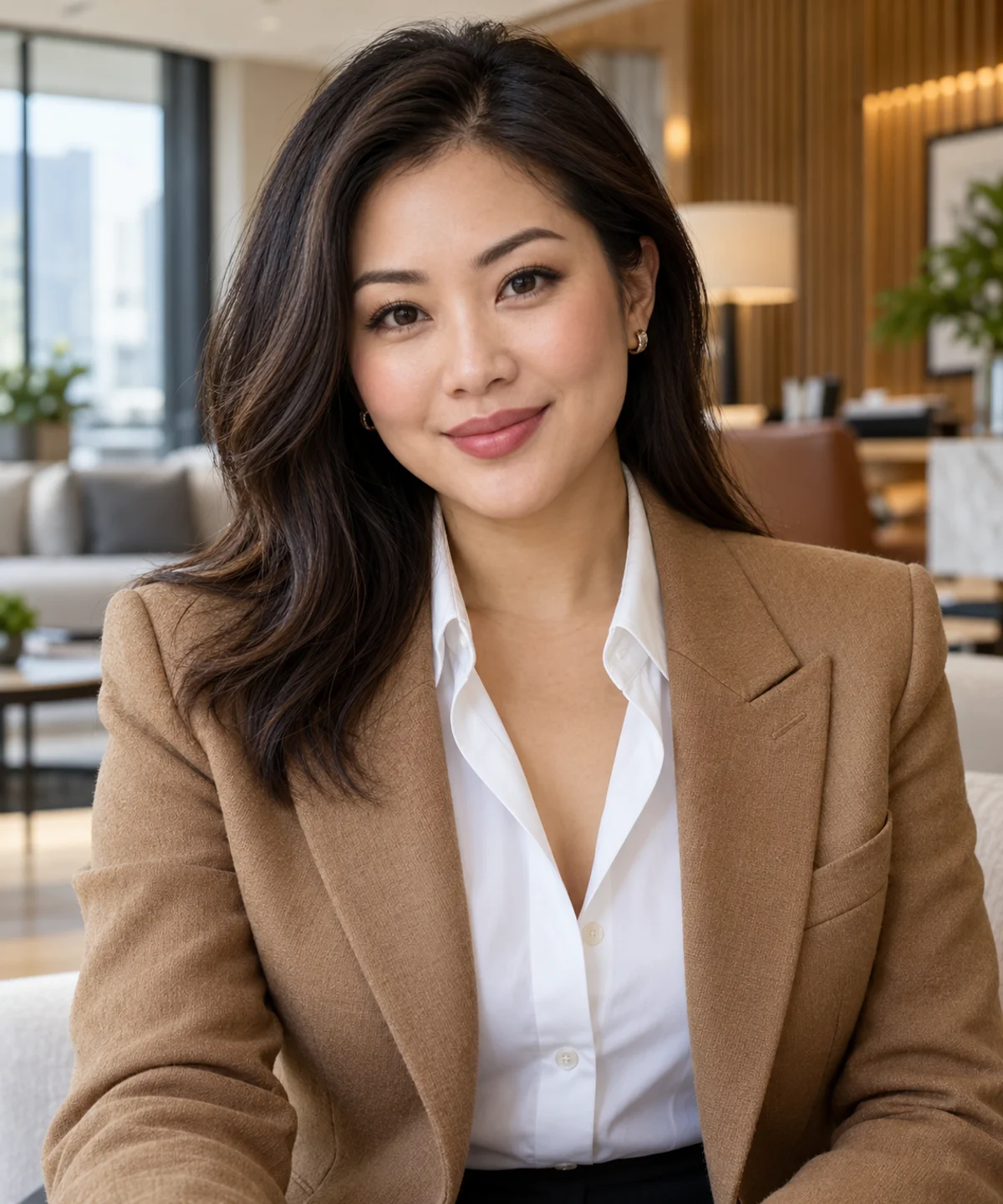
Illustrative AI-generated styling reference: Pairing an open V-neckline with a structured blazer lapel creates clean vertical lines below the chin.
Necklines, collars, and earrings that create breathing room
What happens between your chin and your collarbone has just as much impact on your face shape as your haircut:
- Open necklines: V-necks, wrap tops, scoop necks, sweetheart necklines, and button-downs worn with the top two buttons undone lengthen the neck and break up roundness around the jaw.
- How to wear crew necks and turtlenecks: You do not need to throw away high-necked sweaters. Layer an unbuttoned blazer, cardigan, or trench coat over a crew neck, or add a pendant necklace that forms a V-shape on top of the knit.
- Structured shoulder seams: Soft, slouchy raglans can echo roundness, whereas a crisp jacket lapel or well-fitted shoulder seam introduces subtle geometry.
- Earring geometry: Large round button studs or wide circular hoops sitting right next to the jawline repeat the circle of the face. Linear drop earrings, elongated ovals, teardrops, or rectangular links that hang slightly below the earlobe introduce a clean vertical counterpoint. If you wear eyewear, see how to build a look around your glasses so your frames and earrings work together instead of competing.
A 10-minute home mirror checklist
You can test these principles today using clothes you already own:
- Stand in front of a window and take one quick reference photo in a crew-neck tee with your hair parted in the center.
- Shift your hair part slightly to one side and tuck one side behind your ear—or clip your hair up with slight lift at the crown.
- Swap the crew neck for a V-neck, wrap top, or an open collar shirt, and put on a pair of drop or elongated earrings.
- Apply blush slightly higher along the cheekbone toward the temple.
- Take a second photo from the same distance and compare the two side by side. Notice which details make you feel most like yourself.
If you would like to see how two complete hair, makeup, and outfit directions come together from a single portrait, explore our AI makeover guide or review our one-time plans and pricing.