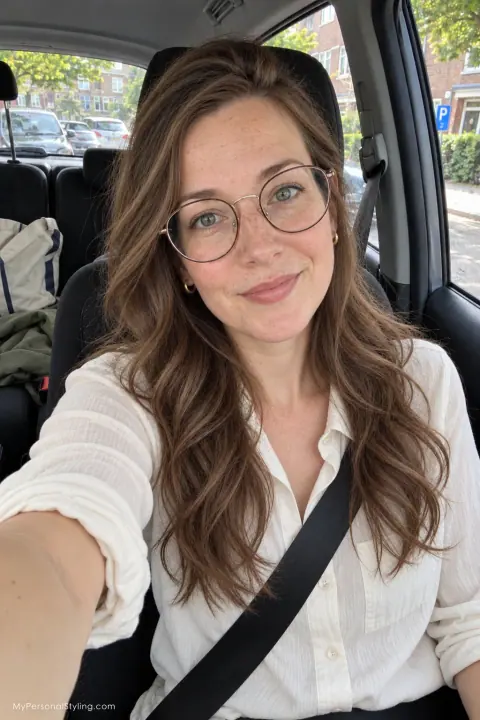
To explore a different hairstyle without cutting your length, start with changes you can undo: a parting, the way you arrange your hair or an accessory you already own. Compare one option at a time and note whether it feels comfortable and practical for your routine.
The purpose is to learn what you like before making a haircut decision. You may discover that a small styling change is enough, or you may gather clearer questions to discuss with a hairstylist later.
Decide what “keeping the length” means to you
You might want to keep enough hair for a ponytail, leave the front pieces long enough to tuck behind glasses or avoid changing an outline you already enjoy. These are different preferences, so name the one that matters most.
Write a short note: “I want a different feeling, but I want to keep \_\_.” This makes it easier to evaluate a suggestion without being distracted by every detail in a reference image.
Keeping the length does not mean you need to follow a particular style category. You can explore a quieter change, a more noticeable arrangement or no change after all.
Compare the parting before changing the cut
If it is comfortable for your hair, try a slightly different parting using your usual tools. Keep the lighting and camera position similar if you take comparison photos.
Notice how the hair sits around the forehead and the sides of the face, but also how it behaves when you move. Does it fall into your eyes? Does it return to its usual position? Does maintaining the arrangement require more attention than you want to give it?
You do not need to force your hair into a position that feels uncomfortable or does not stay in place. The information is useful even when the answer is that your original parting works better for your routine.
Change placement, then look from the side
Compare wearing your hair as usual with tucking one side, arranging it behind your shoulders or using a low, comfortable style you already know how to create.
Look from the front and side. If you wear glasses, notice the relationship between the arms, the hair and any earrings. A still photo can miss catching or pressure, so turn your head and go through an ordinary activity.
You can keep the clothes and accessories the same while comparing the arrangement. That makes it easier to see whether it is the hair placement you like, rather than a change to the entire outfit.
Our guide to styling with glasses offers additional comparisons involving hair placement, earrings and necklines.
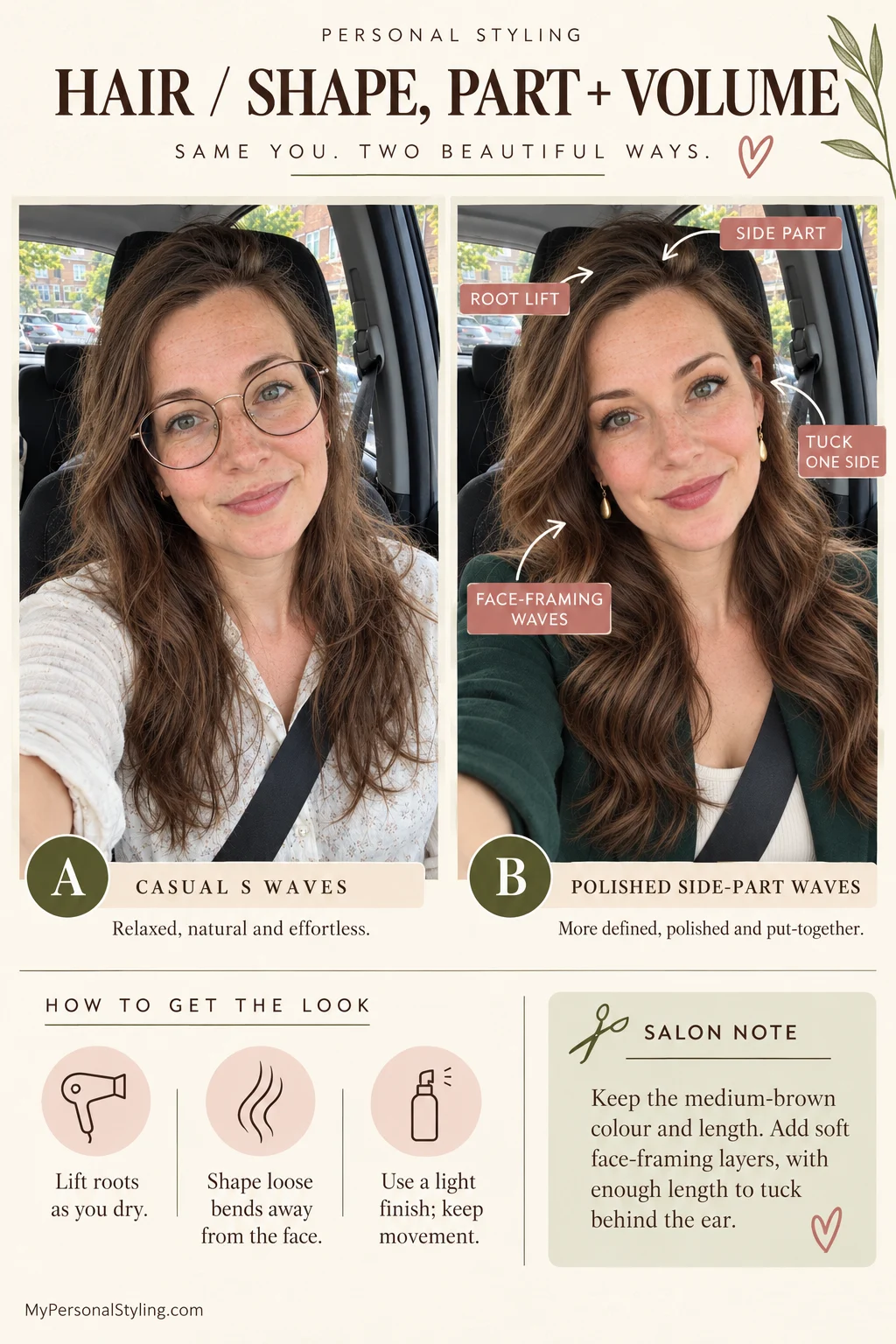
Try an accessory you already have
If you enjoy accessories, compare a familiar clip, barrette or headband. Choose something that is comfortable to put in and remove, and stop using it if it pulls or irritates.
A different accessory can change how the hair is arranged without changing the cut. It can also be a practical choice for a particular task rather than a new everyday identity.
Ask two questions: “Do I like this combination?” and “Would I actually use it?” You do not need to buy an entire set of products to answer them. If accessories are not part of your preference, leave this step out.
Separate styling from cutting, color and treatments
A reference image may show several changes at once. A different parting, visible layers, a new color and a finished salon style can blend into one impression.
For this experiment, keep the task narrow: compare arrangements that do not involve cutting, coloring or treating your hair. Do not assume that a method becomes simple or suitable for everyone because it appears in a short video.
You also do not need heat tools to begin these comparisons. If a look appears to require a technique you do not normally use, note that question rather than treating the image as an instruction you must reproduce.
Keep a small comparison record
Choose two or three arrangements across a few normal days. You can keep photos private on your own device, or use written notes if you prefer not to take photos.
For each version, record:
- What changed: parting, placement or accessory.
- What stayed the same: length, glasses or clothing.
- How long the arrangement took using your actual routine.
- Whether it stayed comfortable during your day.
- The detail you would like to keep or explore further.
Try not to decide from one photograph alone. A version you like in a still image might need more adjustment than you want, while a subtle change may be easy to repeat.
If you use an AI preview, treat it as an idea
An AI makeover preview may help you name a detail you are curious about. It may also change the apparent texture, volume, length or other features unintentionally.
Compare the reference with your original photo and separate what is visible in the image from what you have confirmed in real life. A generated preview cannot show exactly how your hair will behave or guarantee a salon result.
You can read the public MyPersonalStyling sample to see how an illustrated plan organizes different styling ideas and next steps. All portraits in the sample are fictional AI-generated illustrations, not customer transformations.
When you are ready to discuss a haircut
Bring your notes as well as any reference image. Tell your stylist what you want to keep, which arrangement or outline you liked and what your morning routine involves.
If the reference is generated, say so. Ask which parts could translate to your actual hair and which would need to change. Agree on the shortest acceptable length before cutting starts. Our haircut consultation guide includes a fill-in card for that conversation, and our city stylist and salon directory lists consultation-first studios if you want in-person advice.
You can finish the experiment by deciding to keep your current cut. The useful outcome is a clearer preference, not a requirement to make a bigger change.
Frequently asked questions
How can I make my hair look different without cutting it?
Test one reversible change at a time: shift your parting slightly, tuck one or both sides behind your ears to open the jawline, or gather the hair into a low clip at the nape of your neck while keeping your outfit and glasses constant.
Why does my hair look different in reference photos than in real life?
Reference photos often combine a haircut, hair color, studio lighting and heat styling into a single image. Separating reversible placement changes from cutting or heat styling helps you identify what works with your natural texture and morning time limit.
What should I tell my hairstylist if I want a refresh but want to keep my length?
Start by naming your non-negotiables—such as keeping enough length for a ponytail or tucking front pieces behind your glasses—and ask your stylist to point to both the overall perimeter and any face-framing pieces on your dry hair before cutting.